
The New York Times, often maligned in these pages, has served us well in the run-up to the 25th anniversary of 9/11 and especially with two among a slew of good articles. One, a beautiful photo-essay of the 2001 New York Yankees post-attack post-season run, that more than anything else united The City in defiant resolve that “they” can’t take these things away from “us”. That post-season run occurred while additional attacks were not merely predicted but guaranteed by Defense Secretary Donald Rumsfeld and while anthrax-laced letters arrived daily in NYC and D.C. killing postal workers and others. Despite that, on many nights 65,000 fans in the Stadium screamed at the sky and were joined in their defiance by a bald eagle named Challenger and a mayor and president, they didn’t much like, but loved during that period.
 The second Times piece titled “Sept. 11 Shaped Their Lives, but They Don’t Remember It” chronicles the struggle of young New Yorkers, born after or soon before 9/11, to understand why it still is such a big deal for city-dwellers older than they and why it profoundly affects their lives.
I find that struggle odd and depressing as a Boomer whose primary NYC public school education was filled with explanation and discussion of why the then recent Second World War – that began with Pearl Harbor and ended with Hiroshima and Nagasaki incinerated – was important to us and for us to understand. Similarly, we were educated on why the far more remote Civil War, America’s Revolution and early years were vitally important for our lives nearly a hundred and almost two hundred years later. By the sixth grade every student at P.S. 164 in Queens could recite Santayana’s aphorism that “those who cannot remember the past are condemned to repeat it” and a decent share of those eleven-year-olds understood what George was telling us.

Alfred E. Neuman & George Santayana
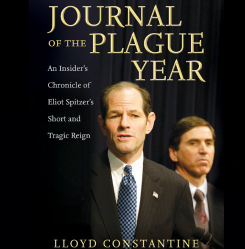
So here, for HL’s Gen Z readers and my grandchildren, who might read this a decade or two from now, is a remembrance of that day from a book about a legal case I was litigating on 9/11/2001, written 8 years later and where I tried to convey the danger and folly of forgetting or failing to understand:
“On 9/11 I was on my way into my law firm’s Manhattan office, on Madison and 51st, diagonally across from the back of St. Patrick’s Cathedral, when I first heard the reports. At that point, only one tower had been hit. As the morning went on, our firm experienced the event as millions of other families did. Each few minutes brought another indelible image. I was on the phone with NY Attorney General Eliot Spitzer five minutes after he witnessed the second plane hit the South Tower, as he was looking through his window in the Attorney General’s office at 120 Broadway, a few hundred yards from Ground Zero. Eliot had interned for me in the South Tower in 1982.
 As a group, our firm watched the Twin Towers collapse and the streets of Nablus and East Jerusalem erupt in wild jubilation. Eliot called again to find out what was going on uptown, and I told him to gather his staff and “get the hell out of there.” Eliot then led his contingent from the AG’s office, who walked from lower Manhattan to the Governor’s NY City headquarters at 633 Third Avenue near 40th Street, where I would serve as his senior advisor years later. Everybody at our firm was able to quickly and mercifully get in touch with their immediate families, except one lawyer, Stacey Mahoney. Carl, her husband, who worked near Ground Zero at Pine Street and Maiden Lane, appeared to be lost. Later he was found dazed, alive, and physically unhurt. Still later, we were told that Neil Levin, a friend whom I had vacationed with weeks before, had perished after making sure that most of his staff at the Port Authority were safely evacuated from the North Tower.
 Right after that, we got word that Stacey Sanders, the daughter of John Sanders, one of our clients, had perished while working for Marsh & McLennan in the North Tower. Within months, Alison Ross, a dazed young woman, would come to work with us on the Merchants’ case. Her father, Richard, had been on one of the planes flown into the towers. Alison’s sister Abigail, Richard Ross’s older daughter also lost her best friend, Stacey Sanders, that day.
The “more fortunate” New York families experienced and continued to experience September 11, 2001, in the horrendous but slightly removed manner that our firm did. By 4:00 pm on 9/11, I turned back to the trial preparation project I had begun the week before and forced myself to go through the motions of working for awhile. The impulse that motivated me to do some work, or at least make believe, was the same as described by many friends and acquaintances. Our work, customs, and rituals would see us through, and wouldn’t let “them” take that away. After that, I walked home with a close friend from the Kaye Scholer law firm, who was afraid to walk home alone.”

0 Comments