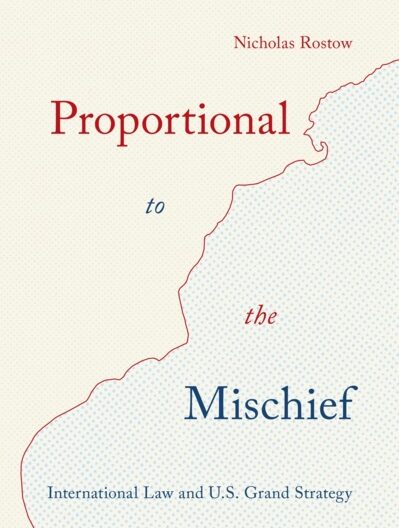
Nicholas Rostow’s new book Proportional to the Mischief – International Law and U.S. Grand Strategy” (Carolina Academic Press, May 1, 2026) is an intelligent, incisive and urgently needed call for the United States to resume formulating and adhering to a grand strategy in its international endeavors.
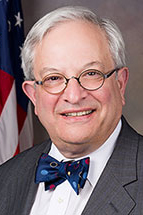
Nicholas Rostow
Rostow brilliantly argues America’s international grand strategy should incorporate and roughly adhere to certain core principles of international law.
This would be a resumption, as Rostow explains, because the U.S. has had no international grand strategy since the Cold War ended with the dissolution of the Soviet Union in December 1991.
Rostow, a distinguished and deeply credentialed diplomat, lawyer, historian of international law and politics and expert on warfare, including cyber-aggression, concluded his book last December (2025) but delivered it just in time. At this dangerous moment when its learning can be contrasted with the Trump Administration’s 2026 foreign adventures. With Venezuela, Iran, Cuba, Greenland/Denmark, the Nato alliance and whatever it’s doing vis-a-vis China. And those comparisons can be done without the type of 20/20 hindsight that daily is being dispensed by talking and writing heads who possess far less knowledge and hands on experience than Rostow, who has advised several presidents, both houses of Congress and the State Department on the matters addressed in his book.
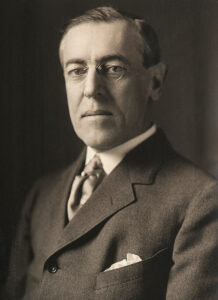
Woodrow Wilson
Rostow, who has taught at schools as diverse as the Naval War College, Yale, Cornell, Colgate and Hamilton, marshals the writings and practices of Thucydides, Clausewitz, Kissinger, Churchill, Woodrow Wilson, Harry Truman, John Foster Dulles and Dwight Eisenhower, among others, to define and advocate for a grand strategy suited for the U.S. as world superpower and arguably still its only one. That strategy is an adaptation of U.S. policy during the dual super power Cold War period (1945-1991) when the U.S. sponsored and hosted the formation and early operations of the United Nations. Rostow explains the U.N. as an improved League of Nations, that was conceived by Woodrow Wilson, contemporaneous with his recognition that the U.S. had become the world’s top dog and needed a grand strategy to serve its interests, not only in foreign affairs but domestically as well. As Rostow chronicles, Congress and Wilson’s Whitehouse successors refused to join the League and separated the U.S. from Europe as the continent lurched toward World War II, a mere 21 years after the Armistice of November 11, 1918. Rostow shows that when “England Slept”[1] and the U.S. tried to be “an island entirely of itself”[2] the most destructive war in world history resulted, ending with Hiroshima, Nagasaki and the dawn of the nuclear age. With that America’s tragic romance with isolationism ended and was replaced by a Truman grand strategy sloganeered as America “keeping the world safe for democracy” but intended to do just that. Most of that involved containment of the Soviet Union and the spread of communism, especially after the U.S.S.R. became the second nuclear power in 1949.
Rostow explains how Truman’s grand strategy was rigorously re-examined, debated, and war-gamed in the Eisenhower years and at the president’s direction, in an effort called “Project Solarium.”
The goals of the Eisenhower grand strategy that emerged were continued containment of the U.S.S.R. and communism, alliances with developed and nascent democracies in the North Atlantic and Southeast Asian regions (NATO and SEATO) and peace. Though peace was defined loosely as the absence of nuclear war.
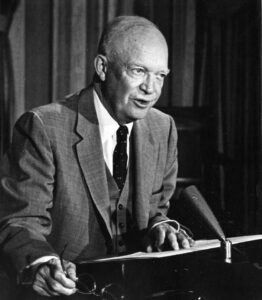
Dwight Eisenhower
Rostow explains how the Soviet Union’s collapse and the bitter after-taste of the Vietnam War resulted in no grand strategy after Clinton took office in 1993. The new president specifically rejected the efficacy of a grand international strategy in favor of ad hoc responses to tragedies like the ethnic cleansing that occurred in the Bosnian War of 1992-1995 and the genocide of Rwandan Tutsis in 1994. Clinton responded to the former with active world leadership and the latter with passivity bordering on acquiescence. Rostow’s argument is that the lack of a coherent grand strategy results in such dangerous inconsistency.
Rostow’s greatest, among many, contributions in this book is dispelling the common misperception that harmonizing U.S. foreign policy with core principles of international law entails substantial surrender of its sovereignty. And that it would result in the U.N.’s International Court of Justice and the “Rome Statute’s” International Criminal Court ruling and overruling U.S. courts and other government institutions. Not so. The core principles that Rostow argues should be part of our grand strategy are necessity, proportionality and distinction. War and even the threat of force should be waged by the U.S. only when necessary to defend itself or allies.

Thucydides
Force should be used proportionally. Not meaning tit for tat or an eye for an eye but the force necessary to prevent a reoccurrence of the violence that makes such force necessary. In waging such wars, the U.S. must distinguish between combatants and civilians.
As noted above, among the best things about Rostow’s well-timed book is that it allows the reader to compare what the U.S. has done internationally this year with policies that Rostow explains worked best from the time of Thucydides through Bush 41. I recommend the reader engage in this exercise with this fine book and end this review with one such exercise of my own. This year U.S. armed forces have summarily executed 185 foreign civilians in 54 boat strikes. Now think of a U.S. that has returned to a grand strategy of maintaining peace, in which democracy can develop and thrive and where the threat and use of force adheres to the principles of necessity, proportionality and distinction. Examine these boat strikes with the light that Nick Rostow has shined on this subject.
[1] John F. Kennedy’s Senior Thesis at Harvard in 1940.
[2] John Donne, Devotions Upon Emergent Occasions.

0 Comments