
When in the fourth semester at a school regularly rated as equal or higher than Harvard, I got my first A-, I took my three suitemates to HoJos for fried clams and milkshakes, because it was the highest grade any of us had gotten as of that halfway mark in college. And two years later when I got an undiluted A, I experienced momentary delusions of divine grandeur, because we had been told that God alone deserved that grade, at least in the humanities and social sciences.
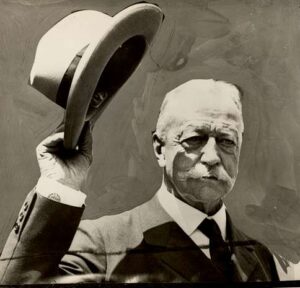
A. Lawrence Lowell
With me now certified as a member of the “when I was a kid I walked to school” generation, my revulsion was automatic when automatic A’s became standard in American higher ed and especially at the roughly 30 highly selective schools among them. And I was not merely revolted by those meaningless yet harmful grades but also the target of some student revolts when I gave grades in the B and C ranges to my college and law school students. The former a good grade in my book and the latter, a grade that a “gentleman” could reveal to parents without fear of disinheritance.
Using those same grading criteria, the faculty of Harvard College gets a D- (the grade I “earned” in calculus) for its recent grading initiative reported in the May 20, 2026 New York Times article. “Harvard Caps A’s as Selective Colleges Attack Grade Inflation.”

Amanda Claybaugh
As reported, the Harvard faculty decided that beginning in the fall 2027 semester “only” 20 percent of the grades in an undergraduate class can be A. However, in truth, a much higher percentage will get that grade, as the Harvard faculty intends. That is because, when the faculty voted to limit to 20 percent the number of A’s, it also provided for up to 4 additional A’s above that percentage. Harvard fed the Times an example using a Harvard class of 100 students, where 24 A’s could be given, i.e., 20% of 100 plus 4. But as Harvard boasts, its median undergrad class size is 12 students. 71 percent of its classes have 20 or fewer students and roughly half have 10 or fewer. So in the typical Harvard class half or more of the students can receive an A and we predict that they will, while virtually all of the rest will receive an A-. Because the faculty made no limitation other than its deceptively packaged pure A quota.
Of this work, Amanda Claybaugh, Harvard Dean of Undergraduate Education said – “This is a consequential vote . . . it will, I believe, strengthen the academic culture of Harvard, it will also, I hope, encourage other institutions to confront similar questions with the same level of rigor and courage” (emphasis added).
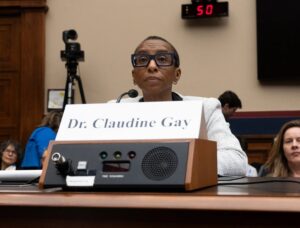
Claudine Gay
A modest self-assessment from a leader of the same school that recently elevated one of her peers, in the faculty to become President of Harvard University, despite having adjudicated her a plagiarist, and then fired her only after she humiliated herself and Harvard in Congressional testimony about anti-Semitism and free expression on the Harvard campus. A campus rated by its own students 245th among 257 in the annual free speech and open expression rankings of The Foundation for Individual Rights and Expression (“FIRE”).
Harvard’s A quota is a bad idea and would be even if, contrary to the faculty’s real intention, was designed to limit that grade to a small percentage of students. Because that would prevent real recognition for real merit, when sometimes is the case, all or most students in a particular class have performed superlatively. It is noteworthy that Harvard has a history of notorious quotas.[1] Quotas eliminate the tedious work of individualized evaluation that benefits those evaluated, the evaluators and the institution itself.
 In contrast, last month Yale released a far more honest and sober mea culpa, concerning the numerous degradations in educational quality at Yale, Harvard and other elites, including meaningless inflated grades. Yale’s self-assessment has far more capacity to influence schools that really want to recognize and attempt to fix their problems, unlike Harvard apparently.
[1] For decades Harvard maintained a 15 percent quota on Jewish students, first adopted in 1922 by Harvard President A. Lawrence Lowell and philosophy professor William Earnest Hocking. While succeeding in reducing the percentage of Jewish students, Harvard was pilloried in the press and suffered serious, if ephemeral, reputational damage. With that lesson in mind, in this century Harvard adopted a tacit and de facto quota on American-Asian students. That policy spawned the federal litigation that sadly resulted in SCOTUS ruling unconstitutional all affirmative action admission programs for racial minorities. The highlight in the case was a Harvard admissions officer’s memo explaining why an applicant who was first in class with perfect SATs was rejected. The American- Asian applicant was “the proverbial picket fence.” As per the Harvard admissions office, applicants who apparently earned their perfect grades and scored perfectly on standardized tests were just identical pickets in an American-Asian fence.

0 Comments